.png)
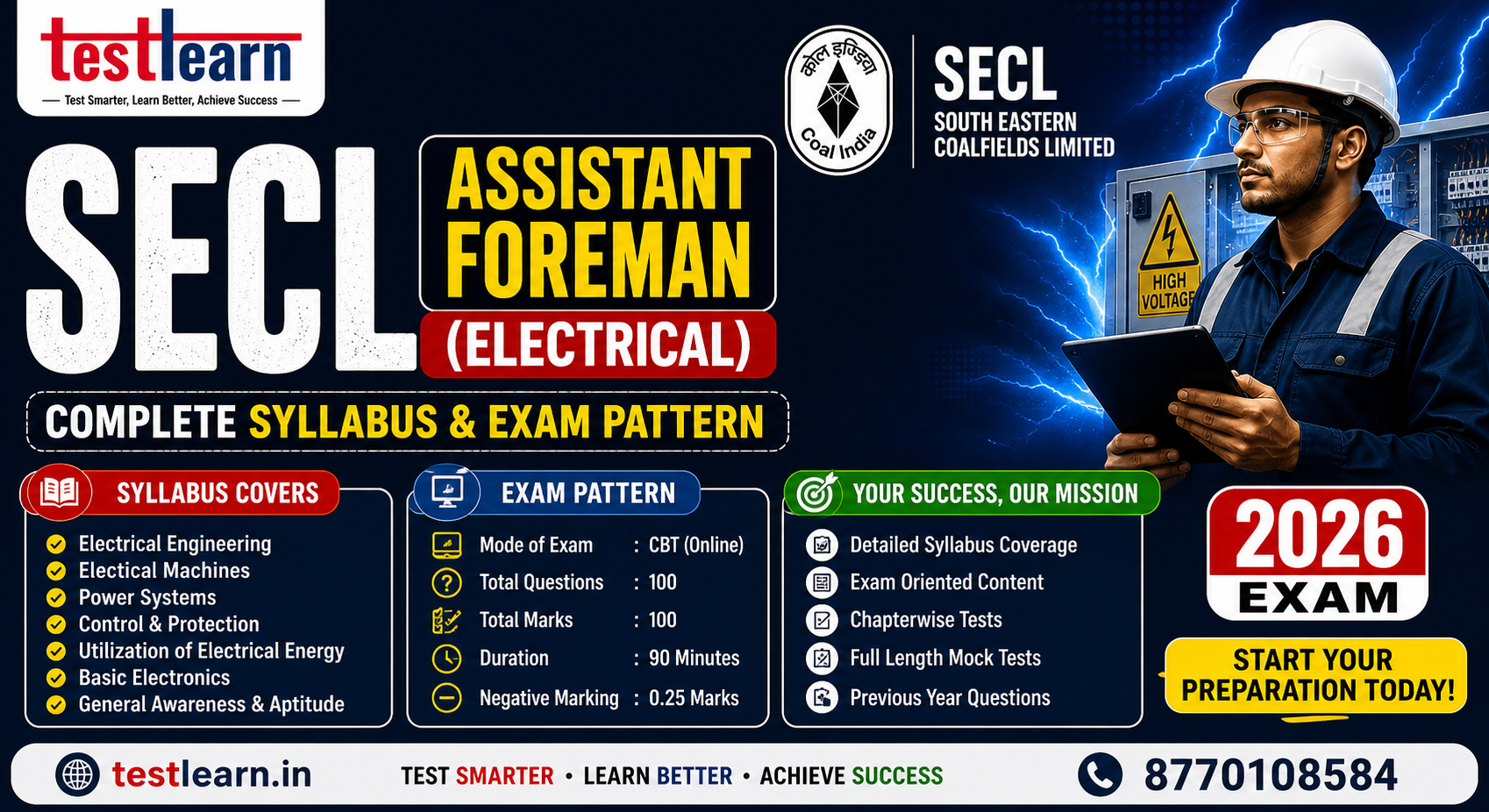
SECL Assistant Foreman (Electrical) Syllabus
Syllabus for the Computer Based Test for Open Recruitment to the post of Assistant Foreman Electrical
Complete Syllabus & Exam Pattern
Exam Pattern (Computer Based Test)
Total Questions
100
Total Duration
2 Hours
Correct Answer
+1 Mark
Negative Marking
0
| Section | Subject / Topic | Questions | Marks |
|---|---|---|---|
| Part - A | Subject Knowledge (Electrical Engineering) | 80 | 80 |
| Part - B | General Knowledge (CIL/SECL & CG/MP State) | 10 | 10 |
| General Awareness (Mental, Quantitative & Logical) | 10 | 10 | |
| Total | 100 | 100 | |
Part - A: Subject Knowledge - 1 to 4
Annexure -1
1. Electrical theory (Elementary Knowledge):-
- Principle of Electricity: Electric voltage, current and resistance, Ohm's law and explanation-Specific resistance - Kirchhoff's - Wheatstone's bridge - Meter bridge., law of resistance and their application for calculating voltage drop, series and parallel circuit, practical unit of voltage, current, resistance, inductance, capacitance, power and energy.
- Relation between electric power unit(KW) and mechanical power unit(HP).
- Work, Power, Energy and Heating effects of Electric Current.
- Conductance- Conductivity - effects of temperature on resistance.
- Electro Magnetism: Concept of electro magnetic force(EMF), Production of E.M.F., flemings right and left hand rules, Natural and artificial magnets magnetic field and magnetic lines of force Coulomb's inverse square law Permeability Magnetic materials. Magnetic properties of material, electomagnets and their application.
- Electrical Materials: Conductors, semiconductors and insulated material and their relative merits, transformer oil, effect of heat and moisture on insulation, lubricatnts and their uses.
- Generation of electricity: Source of natual energy, Renewable and non-renewable source method of production of electricity AC and DC.
- Controlling and Switch Gears: Knowledge of verious type of switches, circuit breakers, cutouts, starters, protective devices for both AC and DC motors and their wiring. Wiring Tools and Accessories, Electrical Wiring Joints.
- Transformer: Knowledge of single phase and three phase transformers, their construction, use and maintenance. Phasing out, parallel working, transformer tapings, temperature rise, instrument transformer. Auto-transformers. Testing of transformers.
- Conversions: Principle of operation of motor generator sets, Conversion Techniques- star and delta circuits, Solve problems on Star Delta Transformation.
- D.C./A.C. Generators: Essential components and contructional features, shunt, series and compound dynamos and their characteristics, causes for sparking. Interpoles, commutators and their maintenance, carbon brushes, their adjusment and care. Methods of voltage regulation. Condition of parallel operation.
- Batteries: Primery cell, dry cell, storage or secondry batteries or accumalatora and their installation, Lead acid cell, nickel, iron or alkaline cell. Initial and subsquent charging of batteries. Charching circuit and their calculation, series and parallel ckt. Maintenance of batteries, use of hydrometers.
- A.C. Motors: Theory of induction (squirrel and slip-ring type), synchronous and commutator motors, their uses, method of starting, speed contol and reversal of direction.
- D.C. Motors: Theory of shunt, series and compound wound type motors, their uses, installation, method of starting, speed contol and reversal of direction.
- A.C. Circuits: Kowledge of vector group, phase and phase difference. Resistance, inductance and capacitance in AC circuit. Periodicity or frequency, power and power factor. Single phase and three phase system. star delta connection, phase sequence.
- Illumination: Metal filament lamp, florescent lamp circuit. Photometric units and simple measurements, general requirement of efficient lightening and elementary calculation. Street lighting and time switches.
- Transmission & Distribution:
- a) DC and AC power supply for auxiliaries, arrangement of unit auxiliaries and station service board, station lighting and automatic changeover, station batteries and charging methods. Standby and emergency power and lighting system.
- b) Control and Protection- Sequential operation & interlocks, general machine, start/stop, sequence of operation.
- c) Testing and Measurement- Working principle and basis of instrument and measurements. Details of measuring instrument for pressure, flow, temperature, level, vibration alignment and current, voltage, power, reactive power, frequency, energy, winding temperature, auto controllers, recorder, insulation, tester, its use of primary detection of faults, data acquisition system, digital distributed control, UPS etc. Testing of electrical and mechanical testing equipment's.
- d) Fire safety procedure, fire protection of generator, transformers, and firefighting. Protection and restoration of persons suffering from electric shock.
2. Electricity Utilization for:-
Industrial Installation-
- Wiring: Wiring layout of different types such as cleat, metal sheathed, wood casing and capping, cap type sheathed, conduit and armored cable for lighting and power installation in industrial premises together with the necessary switchgear, Wiring of appliances.
- Simple Calculation: Simple calculation relating to cost of power and energy, elementary knowledge of method of charging for demand and energy, electrical power tariff.
- Testing and Fault Attendance: Detection and location of faults in AC and DC circuits, motor, overhead lines and cables, electric instruments, and apparatus. Rectification of fault, insulation and continuity tests, earth resistance.
- Protective Devices: Elementary knowledge of earthling of generator, motors, transformers. Use of lighting arrestors, fuse, including high rupturing capacity fuses, cutouts, circuit breakers, over load and no voltage protection, thermal overload, earth leakage & earth fault protection and different types of protective relays. Earthing system.
- Circuit Diagram: Electrical connection for AC and DC Motors, their starters, main and sub-distribution board with circuit breakers, switches, fuse, MCB, MCCB, battery charging equipment's, rectifiers.
- Pumps: General principal and elementary calculation of head, power and energy requirement for centrifugal pump.
- Power and Energy Measurement and Charges: Measurement of power, wattmeter, energy meter both AC and DC, power factor correction by capacitor.
- Apparatus: Installation and maintenance of generator, motor, transformers, pumps, electric welding, cooling and heating appliances.
Domestic installation-
- Apparatus: Installation and maintenance of heaters, coolers, refrigerator, and other domestic appliances. Electric bell and indicators, Electric fan.
- Wiring: Wiring layout of different types such as cleat, metal sheathed, wood casing and capping, cap type sheathed, conduit and armored cable for lighting and power installation in residential area together with the necessary switchgear, MCB, Wiring of temporary and portable appliances.
- Circuit Diagram: Electrical connection of various circuit for (i) House wiring including those for main and sub-distribution board, switches and cutout etc.
- Simple Calculation: Simple calculation relating to cost of energy, load calculations etc.
- Testing and Fault Identification: Detection and location of faults in domestic appliance and wiring installation. Insulation and continuity test, rectification of fault, insulation and continuity tests, earth resistance.
- Protective Devices: Elementary knowledge of the use of fuses and cutouts, earthing of domestic appliances, motor etc. use of lighting arrestors, earthing systems.
3. HT Power Supply:-
- a) HT Cables- 11 KV & 33KV and Control Cables:
- Criteria for selection of power cables, types of cables, cable laying, terminals, jointing, plumbing of cables.
- Underground and surface junction boxes. Fault locating in cables, power cable sheath fault. Equipment used & methodology for location fault in cable etc.
- b) HT Sub-station and Control Room:
- Layout, design, HT Transformer and associated equipment's (i.e., CBs, Insulators, LAs, Capacitors, CTs and PTs). Sub-station, sub-station earthing, earthing mat, tower grounding.
- Power and distribution transformers, their erection, testing and commissioning, fault location and maintenance.
- Protective relays and measuring equipment's and their working.
- Testing, fault location, maintenance and protection of HT cables and measuring equipment.
- Design and installation of capacitor bank and their maintenance.
- Erection, testing, commissioning, and maintenance of control room equipment's including station batteries and communication system.
- Maintenance of earth pit, LA, fire fighting systems.
- c) HT Overhead line - 11KV & up to 33KV:
- Survey, design, construction standard, foundation erection testing and commissioning.
- Testing, fault location, commissioning, maintenance, and protections, including safety devices and testing equipment's.
- Selection of supports, cross arm brackets, stay, struts, insulators, and associated hardware.
- Type and size of conductor, length of spans, sag, spacing of conductors, effect of temperature, wind pressure, ice and snow on tension of conductors, lighting on conductors.
- Knowledge about construction standards of overhead lines, sub-station and other equipment's utilized in this HT system.
- General requirement of earthing, guard wires, relays and other protective devices, size of earth conductors, pole earthing, lightning arresters, and maintenance of LA
4. Other Basic Knowledge; -
- a) Operational knowledge on measuring instrument i.e., oscilloscopes, ammeters, voltmeters, millimeters, tongue tester, meggers, and HV testing kits.
- b) Tariffs, energy charges, power factor, penalty - Chhattisgarh state and MP state.
Part - B
Marks - 20- a) General Knowledge: Regarding CIL/SECL related questions & Chhattisgarh state & MP State related questions
10 Questions / 10 Marks
- b) General Awareness: Mental ability/Quantitative ability/Logical & Reasoning skills
10 Questions / 10 Marks